

Revista Portuguesa de Estomatologia, Medicina Dentária e Cirurgia Maxilofacial
SPEMD - SPEMD - Revista Portuguesa de Estomatologia Medicina Dentária e Cirurgia Maxilofacial | 2026 | 67 (2) | 80-90
Original research
Rotary instrument system preferences in endodontic retreatment among dentists in Turkey
Preferências quanto a sistemas de instrumentos rotativos no retratamento endodôntico entre dentistas na Turquia
a Department of Endodontics, Faculty of Dentistry, Antalya Bilim University, Antalya, Turkey
b Department of Endodontics, Faculty of Dentistry, Marmara University, Istanbul, Turkey
Esma Fatima Delica - esmadelican@gmail.com
Article Info
Rev Port Estomatol Med Dent Cir Maxilofac
Volume - 67
Issue - 2
Original research
Pages - 80-90
Go to Volume
Article History
Received on 05/02/2026
Accepted on 15/06/2026
Available Online on 30/07/2026
Keywords
Original Research
Rotary instrument system preferences in endodontic retreatment among dentists in Turkey
Preferências quanto a sistemas de instrumentos rotativos no retratamento endodôntico entre dentistas na Turquia
Esma Fatima Delican1,* 0009-0009-6938-8465
Emre Iriboz2
1 Department of Endodontics, Faculty of Dentistry, Antalya Bilim University, Antalya, Turkey
2 Department of Endodontics, Faculty of Dentistry, Marmara University, Istanbul, Turkey
Article history:
Received 5 February 2026
Accepted 15 June 2026
Available online 8 July 2026
Abstract
Objectives: This study aimed to evaluate dentists’ self-reported use of rotary instrument systems and related selection criteria during non-surgical endodontic retreatment in Turkey, and to identify demographic and professional factors associated with these outcomes.
Methods: A nationwide, cross-sectional, web-based survey consisting of 14 structured questions was distributed to practicing dentists in Turkey. The questionnaire assessed demographic characteristics, self-reported retreatment practices, rotary instrument system use, selection criteria, perceived disadvantages, perceived causes of instrument fracture, and irrigation protocols. Data were statistically analyzed. Associations between categorical variables were evaluated using Pearson’s chi-square and Fisher’s exact tests.
Results: A total of 565 dentists were included. Associations involving retreatment performance by specialty status, rubber dam use by specialty status and years of clinical experience, and irrigation activation use by specialty status survived Bonferroni correction. Associations involving gender and rubber dam use, specialty status and self-reported rotary instrument system use, and general practitioners’ reporting of time efficiency reached nominal significance only and were interpreted as exploratory.
Conclusion: Working principle and file design were the most commonly reported selection criteria for rotary systems during retreatment. Self-reported clinical practices differed according to specialty status and years of clinical experience, whereas gender-related associations were nominal and should be interpreted as exploratory.
Keywords: Dental instruments,Dentists,Root canal therapy
Resumo
Objetivos: Este estudo teve como objetivo avaliar a utilização autorrelatada de sistemas de instrumentos rotativos e os respetivos critérios de seleção por médicos dentistas na Turquia durante o retratamento endodôntico não cirúrgico, bem como identificar fatores demográficos e profissionais associados a estes resultados.
Métodos: Foi realizado um inquérito nacional, transversal e baseado na internet, composto por 14 perguntas estruturadas, distribuído a médicos dentistas em exercício na Turquia. O questionário avaliou características demográficas, práticas autorrelatadas de retratamento, utilização de sistemas de instrumentos rotativos, critérios de seleção, desvantagens percecionadas, causas percecio nadas de fratura de instrumentos e protocolos de irrigação. Os dados foram analisados estatisticamente. As associações entre
variáveis categóricas foram avaliadas através do teste do qui-quadrado de Pearson e do teste exato de Fisher.
Resultados: Foram incluídos 565 médicos dentistas. As associações que envolviam a realização de retratamento por especialidade, a utilização do dique de borracha por especialidade e por anos de experiência clínica, e a utilização de sistemas de ativação da irrigação por especialidade permaneceram significativas após a correção de Bonferroni. As associações que envolviam a utilização do dique de borracha por género, a utilização autorrelatada de sistemas de instrumentos rotativos por especialidade, e a perceção de eficiência temporal por médicos dentistas generalistas atingiram apenas significância nominal e foram interpretadas como exploratórias.
Conclusão: O princípio de funcionamento e o design dos instrumentos foram os critérios de seleção mais frequentemente relatados para os sistemas rotativos durante o retratamento. As práticas clínicas autorrelatadas diferiram de acordo com a especialidade e os anos de experiência clínica, enquanto as associações relacionadas com o género foram apenas nominais e devem ser interpretadas como exploratórias.
Palavras-chave: Instrumentos dentários,Médicos dentistas, Terapia do canal radicular
Introduction
When primary root canal treatment fails, non-surgical endodontic retreatment is generally considered the first-line approach because it enables removal of previous filling materials, re-disinfection of the root canal system, and subsequente re-obturation while preserving the natural tooth.1, 2 Clinical studies have shown that the outcome of retreatment may be influenced by several factors, including anatomical complexity, preoperative periapical status, tooth type, and procedural strategy.3
Although both primary root canal treatment and retreatment involve chemomechanical preparation of the root canal system, retreatment represents a distinct clinical scenario. In retreatment cases, clinicians are required not only to re-instrument the canals but also to remove existing obturation materials, manage complications related to previous treatment, and negotiate potentially altered canal anatomy.4 These challenges may affect instrument selection, working strategy, perceived procedural difficulty, and treatment duration. Therefore, clinicians’ self-reported use of rotary instrument systems and related selection criteria during retreatment should not be assumed to be identical to those used in primary root canal treatment.
The introduction of nickel-titanium (NiTi) rotary systems represents a major advancement in endodontic practice by improving canal shaping efficiency, preserving canal curvature, and reducing operator fatigue.5, 6 In addition, the mechanical behavior of NiTi instruments is influenced by design features, alloy metallurgy, heat treatment, kinematics, and testing conditions, all of which may affect clinical performance and instrument selection.6 However, instruments originally designed for primary canal shaping may not always demonstrate optimal efficiency in retreatment cases, particularly when removal of filling materials is required. Consequently, retreatment-specific systems with modified geometries, tapers, alloy treatments, and kinematic motions have been developed.4
The selection of a rotary system may be influenced by multiple factors, including file design, motion kinematics, fatigue resistance, debris extrusion, clinician experience, and familiarity with a given system. 6 - 10 Although numerous in vitro and ex vivo studies have compared the mechanical performance of different systems, evidence regarding clinicians’ self-reported use of rotary instrument systems and retreatment-related selection criteria remains limited.4, 6, 7
Previous surveys have investigated general endodontic instrumentation trends, NiTi file use, and clinical decision-making patterns among dentists.7, 8, 11 However, evidence specifically focused on the self-reported use of rotary instrument systems during non-surgical endodontic retreatment remains limited, as prior surveys have not comprehensively addressed retreatment-specific selection criteria in this clinical context.
Therefore, the present study addresses a specific gap by evaluating the self-reported use of rotary instrument systems, related selection criteria, and associated clinical practices during retreatment in a nationwide sample of dentists in Turkey.
In this study’s survey, dentists’ preferences for rotary instrument systems during non-surgical endodontic retreatment were defined by their self-reported use and related selection criteria. The null hypothesis was that these outcomes would not differ according to dentists’ gender, years of clinical experience, or specialty status. Accordingly, the aims of this study were to investigate self-reported clinical practices related to non-surgical retreatment, examine self-reported use of rotary instrument systems and related selection criteria, identify demographic and professional factors associated with these outcomes, and evaluate the relationship between clinicians’ professional background and retreatment-related clinical practices.
Material and Methods
This study was approved by the Non-Interventional Clinical Research Ethics Committee of the Faculty of Health Sciences, Marmara University, Turkey, on December 28, 2023 (Protocol No: 2023-152), and was conducted in accordance with the principles of the Declaration of Helsinki. Written informed consent was obtained electronically from all participants before they accessed the questionnaire. To preserve anonymity, no directly identifying personal data was collected.
The study was conducted between June 14 and November 22, 2024, and included dentists actively practicing in Turkey. The questionnaire was developed using Google Forms. Licensed dentists working in private clinics, public hospitals, oral and dental health centers, or university hospitals were eligible for inclusion, whereas dental students and interns were excluded. Participation was entirely voluntary, and responses were screened for eligibility, analyzability, and potential duplication before analysis.
The reporting of this cross-sectional internet-based survey was guided by relevant STROBE and CHERRIES recommendations.12, 13 The survey was distributed electronically through the Turkish Dental Association’s mailing list to licensed dentists practicing in Turkey. A total of 31,625 dentists were reached electronically. The questionnaire was not publicly advertised on open social media platforms, and no individualized access tokens or passwords were used. Multiple entries were minimized by using the Google Forms one-response-peraccount option when technically available and by screening the final dataset for identical or highly similar response patterns.
Because the survey was anonymous, no IP addresses, cookies, device identifiers, or directly identifying personal data were collected. In total, 565 analyzable responses were included in the final analysis, corresponding to a final analyzed participation rate of 1.8%. Link-access analytics were unavailable; therefore, survey opening and partial completion rates could not be calculated.
The questionnaire consisted of 14 structured items, including both single-choice and multiple-choice questions, with multiple responses permitted for selected items. The survey was developed de novo by an academic team comprising one professor and one endodontic specialty resident with endodontic experience, after a focused review of the relevant literature on endodontic practice patterns, retreatment procedures, and rotary NiTi instrument use.5, 14 - 17 Before nationwide distribution, the questionnaire was pilot-tested with a small group of practicing dentists to assess item clarity and applicability, and minor wording amendments were incorporated accordingly. Because the questionnaire consisted mainly of descriptive categorical items rather than psychometric scales, internal consistency analysis was not considered applicable.
No previously validated instrument was available for this specific retreatment-focused context; therefore, the questionnaire was developed de novo for this study.
The first section collected information on gender, years of clinical experience, and specialty status. The second section evaluated self-reported use of rotary instrument systems during retreatment, selection criteria for these systems, expectations and perceived disadvantages, perceived causes of instrument fracture, and self-reported irrigation solutions and activation methods.
As not all respondents completed all items, and some items were applicable only to specific participant groups (e.g., questions on retreatment technique were directed only to those who reported performing retreatment), percentages throughout the Results section were calculated using the number of valid responses for each item. Accordingly, denominators may differ from the total sample of 565, and aggregate totals may not equal 565 across all variables. No formal sample size calculation was performed prior to the study; this is acknowledged as a limitation of the study design. The full questionnaire was provided as supplementary material to improve reporting transparency.
Data were analyzed using IBM SPSS Statistics version 25.0 (IBM Corp., Armonk, NY, USA). Descriptive statistics were reported as frequencies and percentages for categorical variables.
For inferential analyses, Pearson’s chi-square test was applied when expected cell frequencies exceeded five in all cells; Fisher’s exact test was used otherwise. For multiple-response questions, each response sub-item was dichotomized as selected or not selected and analyzed independently as a binary variable, consistent with established methodology for multiple-response survey data. Because responses within a multiple-response set may not be fully independent, findings from these analyses were interpreted as exploratory and descriptive rather than confirmatory.
To address the risk of type I error inflation arising from multiple simultaneous comparisons across demographic strata, all planned bivariate comparisons between demographic variables (gender, years of clinical experience, and specialty status) and survey outcome measures were treated as a single family of tests. A total of 48 statistical comparisons were performed within this family. Bonferroni correction was therefore applied using α = 0.05/48, yielding an adjusted significance threshold of p < 0.00104. Associations surviving this threshold were considered robust to multiplicity adjustment; those reaching only nominal significance (p < 0.05 and p ≥ 0.00104) were designated as exploratory findings.
Effect sizes for all statistically significant chi-square analyses were quantified using Cramér’s V and interpreted according to the following conventional benchmarks: V < 0.10, negligible; 0.10–0.29, small; 0.30–0.49, medium; ≥ 0.50, large.
Additionally, crude odds ratios (ORs) with 95% confidence intervals (CIs) were calculated for the three primary binary outcomes (retreatment performance, rubber dam use, and irrigation activation use) to quantify the magnitude of association with specialty status. The nominal statistical significance threshold was set at p < 0.05, whereas associations were considered robust to multiplicity adjustment only when p < 0.00104.
For p-values close to the Bonferroni-corrected threshold, four decimal places were reported to avoid misclassification due to rounding.
Results
Of the 31,625 dentists contacted electronically, 565 analyzable responses were included in the final analysis, corresponding to a participation rate of 1.78%. The demographic and professional characteristics of the participants are presented in Table 1. Most participants reported personally performing non-surgical endodontic retreatment procedures (81.7%; Table 2). Specialty status was associated with retreatment performance and remained robust after Bonferroni correction (p < 0.001; Cramér’s V = 0.307, medium effect). Retreatment performance was higher among endodontists than general dentists (GDs) and other practitioners (OR = 9.83; 95% CI: 3.75–25.80; p < 0.001). Gender was nominally associated with retreatment performance (p = 0.008; Cramér’s V = 0.112, small effect), but this association did not survive Bonferroni correction and was interpreted as exploratory.
Table 1. Descriptive statistics of the participants’ demographic and professional characteristics
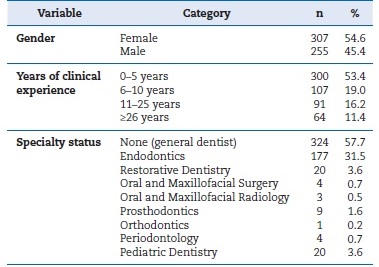
Percentages were calculated based on the number of valid responses for each demographic variable. Therefore, the totals may differ from 565 due to missing responses.
Table 2. Self-reported clinical practices and rotary instrument system use related to endodontic retreatment
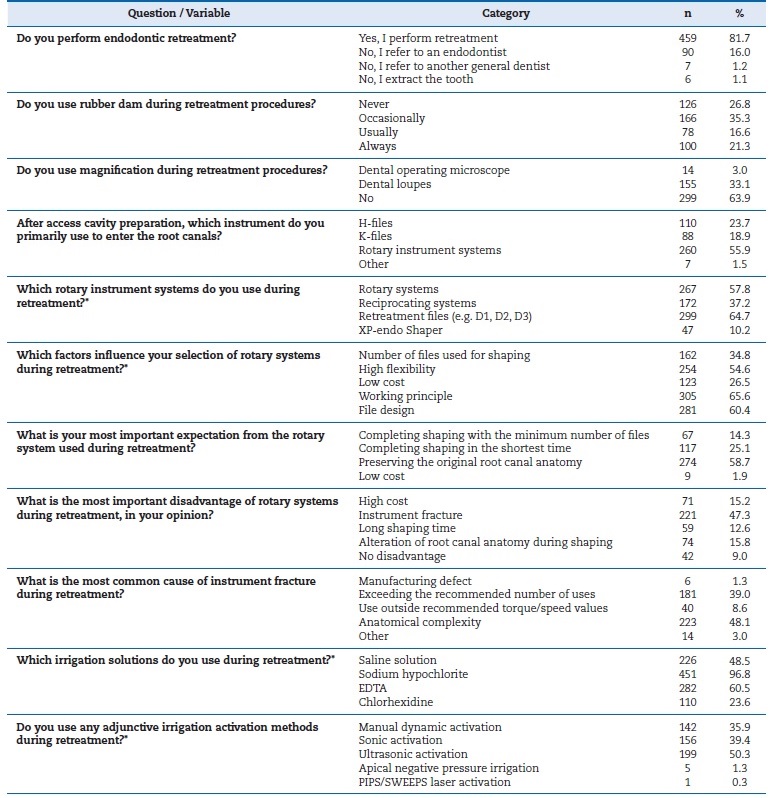
More than one response was permitted for selected questions.
Percentages were calculated based on the number of valid responses for each item. Totals may differ from 565 because of missing responses and/or the conditional applicability of specific questions. For multiple-response items, percentages may exceed 100%.
The category “Retreatment files (D1, D2, D3)” refers to retreatment-specific file systems as a general category and does not indicate a single commercial brand.
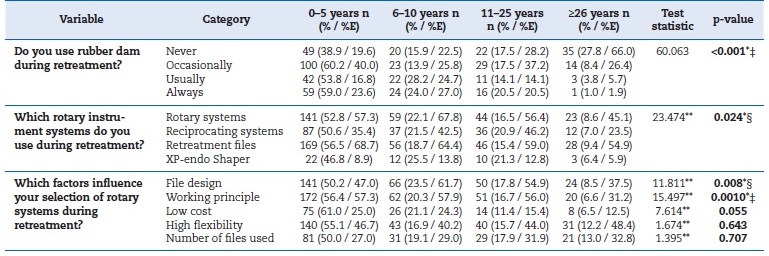
Routine rubber dam use, defined as “always” or “usually,” was more frequently reported by endodontists than by GDs (OR = 3.51; 95% CI: 2.07–5.95; p < 0.001). Years of clinical experience were associated with self-reported rubber dam use, and this association was robust to multiplicity adjustment (p < 0.001; Cramér’s V = 0.158, small effect). Self-reported rubber dam use decreased progressively with increasing years of clinical experience, with the highest proportion of non-use observed among dentists with ≥26 years of experience (Figure 1).
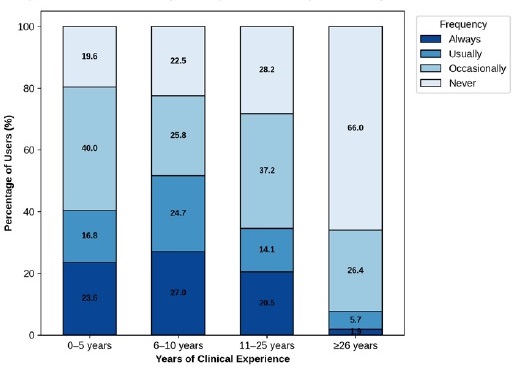
Figure 1. Self-reported rubber dam use during non-surgical endodontic retreatment according to years of clinical experience. Each bar represents 100% of respondents within the corresponding experience group.
Gender showed only a nominal association with self-reported rubber dam use (p = 0.002; Cramér’s V = 0.143, small effect); therefore, this finding was interpreted as exploratory.
Most participants reported not using magnification devices, whereas only a small proportion reported using a dental operating microscope (Table 2). Rotary instrument systems were the most commonly reported method for canal entry after access cavity preparation. The distribution of reported canal-entry methods differed by gender at the nominal level only (p = 0.007; Table 3) and was therefore interpreted as exploratory.
Table 3. Distribution of self-reported clinical practices according to gender and their associations
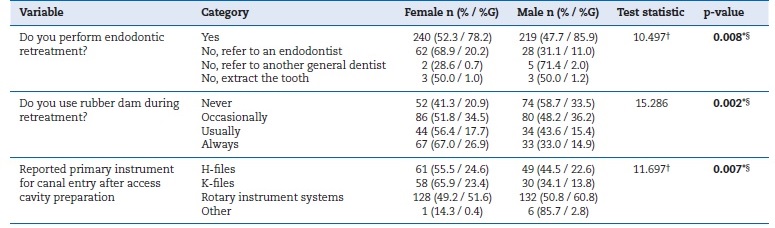
* Nominally significant at p < 0.05.
§ Exploratory (nominal significance only, p < 0.05 and p ≥ 0.00104).
† Fisher’s exact test.
Nominal significance threshold: p < 0.05. Bonferroni-corrected threshold: p < 0.00104.
Percentages are presented as row percentages (%) and column percentages within each gender group (%G).
Because comparisons were performed using the number of valid responses for each analyzed variable, denominators may vary across variables due to missing responses.
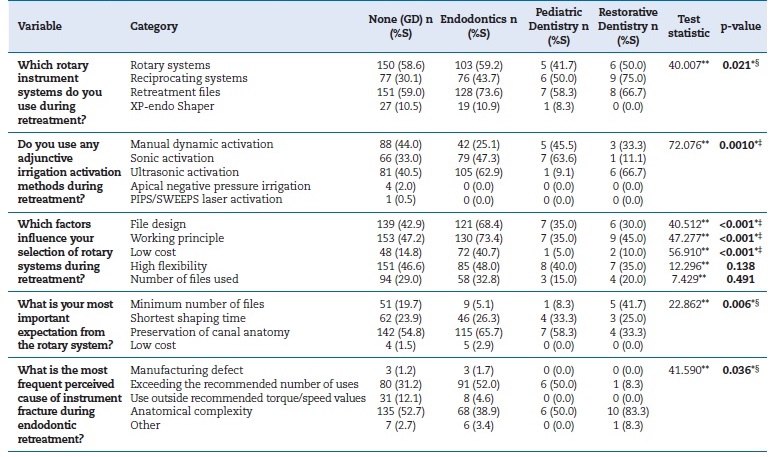
Self-reported use of rotary instrument systems during retreatment showed nominal associations with specialty stat and years of clinical experience; neither association survived Bonferroni correction, and both were interpreted as exploratory (Tables 4 and 5). Specialty status was nominally associated with self-reported rotary instrument system use (p = 0.021; Cramér’s V = 0.098, negligible effect), with endodontists more frequently reporting retreatment-specific file use and GDs more frequently reporting conventional rotary system use (Figure 2). Years of clinical experience also showed a nominal association with self-reported system use (p = 0.024; Cramér’s V = 0.089, negligible effect), with less experienced dentists more frequently reporting retreatment-specific file use; this finding was likewise exploratory.
Table 4. Self-reported retreatment-related practices according to years of clinical experience
* Nominally significant at p < 0.05.
‡ Robust to multiplicity adjustment (p < 0.00104).
§ Exploratory (nominal significance only, p < 0.05 but p ≥ 0.00104).
** Multiple chi-square test.
Nominal significance threshold: p < 0.05. Bonferroni-corrected threshold: p < 0.00104.
Percentages are presented as row percentages (%) and column percentages within each group of years of clinical experience (%E). For multipleresponse items, percentages may exceed 100%. Because comparisons were performed using the number of valid responses for each analyzed variable, denominators may vary across variables due to missing responses.
Table 5. Self-reported retreatment-related practices according to specialty status
* Nominally significant at p < 0.05.
‡ Robust to multiplicity adjustment (p < 0.00104).
§ Exploratory (nominal significance only, p < 0.05 but p ≥ 0.00104).
** Multiple chi-square test.
GD – General dentist; PIPS – Photon-induced photoacoustic streaming; SWEEPS – shock wave enhanced emission photoacoustic streaming
Nominal significance threshold: p < 0.05. Bonferroni-corrected threshold: p < 0.00104.
Percentages indicate column percentages within each specialty group (%S). For multiple-response items, percentages may exceed 100%.
Comparative analyses by specialty were limited to GDs, endodontists, pediatric dentists, and restorative dentists because the number of participants in other specialty categories was insufficient for meaningful statistical comparison. Percentages were calculated using valid responses for each item.
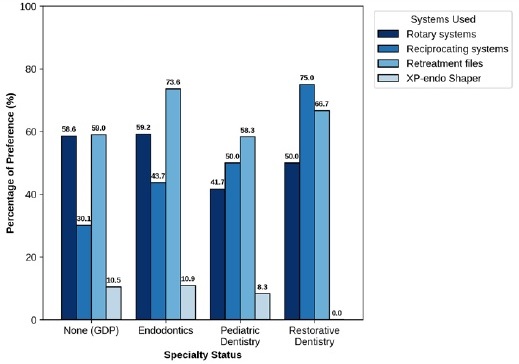
Figure 2. Distribution of self-reported rotary instrument system use according to specialty status. Percentages represent the proportion of respondents within each specialty group who reported using each system. Multiple responses were permitted. GD = General dentist. The association was nominally significant and interpreted as exploratory according to the Bonferroni-corrected threshold (multiple chi-square test, p = 0.021).
The most commonly reported selection criteria for rotary instrument systems were the working principle and file design.
Selection criteria differed by specialty status, with working principle and file design remaining robust after Bonferroni correction (Table 5; p < 0.001). The working principle also differed according to years of clinical experience and remained robust to multiplicity adjustment (p = 0.0010; Cramér’s V = 0.134, small effect), whereas file design showed only a nominal association and was interpreted as exploratory (p = 0.008; Cramér’s V = 0.162, small effect).
Preservation of the original canal anatomy was the most commonly reported expectation from rotary systems. Expectations differed across specialty groups at the nominal level only (p = 0.006; Table 5) and were therefore interpreted as exploratory.
Endodontists more commonly reported anatomical preservation as an expectation, whereas GDs more commonly reported procedural speed and fewer files.
Instrument fracture was the most commonly reported perceived disadvantage associated with rotary systems (Table 2).
Perceived causes of instrument fracture differed according to specialty status at the nominal level only (p = 0.036; Cramér’s V = 0.121, small effect) and were interpreted as exploratory.
GDs more frequently reported anatomical complexity as a perceived cause, whereas endodontists more frequently reported exceeding the recommended number of uses.
Regarding irrigation protocols, sodium hypochlorite was the most commonly reported irrigant, and ultrasonic activation was the most commonly reported adjunctive irrigation activation method. Self-reported use of irrigation activation systems differed by specialty status and remained robust to multiplicity adjustment (p = 0.0010; Cramér’s V = 0.175, small effect). Irrigation activation use was reported by 93.8% of endodontists and 58.3% of GDs. Endodontists had higher odds of reporting irrigation activation use than GDs (OR = 3.08; 95% CI: 1.70–5.57; p = 0.0010).
Discussion
This nationwide web-based survey provides descriptive insight into retreatment-related self-reported clinical practices, rotary instrument system use, and selection criteria among dentists in Turkey. The most robust findings were the associations of specialty status and years of clinical experience with selected clinical practices, particularly rubber dam use and irrigation activation. Associations involving rotary instrument system use, expectations, perceived causes of instrument fracture, and gender-related differences were generally nominal and should therefore be interpreted as exploratory.
Because the study was observational and cross-sectional, these associations should not be interpreted as causal relationships.
A major strength of the present study is its specific focus on retreatment rather than general endodontic instrumentation.
Retreatment differs from primary root canal treatment in terms of procedural objectives, technical complexity, and instrument demands. In this context, the exploratory finding that endodontists more frequently reported using retreatment-specific file systems may reflect greater exposure to complex retreatment cases and stronger familiarity with systems designed for filling material removal. Conversely, the more frequent self-reported use of conventional rotary systems among GDs may be related to routine availability, familiarity, or practical considerations. These interpretations remain inferential because the association did not survive Bonferroni correction, and the survey did not directly assess the underlying reasons for each clinical decision in depth.
Although this response rate appears low, it is consistente with patterns reported in large-scale web-based surveys in dentistry: 51.7% (348 of 673 dentists) in a web-based and faceto-face survey conducted in Korea;15 28.3% (87 of 307 participants) in a web-based survey among endodontists in Turkey;18 5% (283 of 5,858 dentists) in a survey conducted among dentists in the Netherlands.19 As these examples suggest, response rates tend to decrease as the number of invitees increases.
Additional contributing factors may include outdated email addresses and survey links being redirected to spam folders. Despite the low response rate, the absolute number of respondents in this study (n = 565) is comparable to or exceeds that of many previously published endodontic surveys, and the sample includes a diverse range of specialty groups and experience levels.
Consistent with previous surveys conducted in the United States and Turkey,5, 20 male dentists nominally more frequently reported performing retreatment procedures than female dentists. Because this association did not survive Bonferroni correction, it should be interpreted as exploratory. Potential explanations may include referral behavior, risk perception, workplace setting, or case selection; however, these remain speculative and require further qualitative or mixed-method investigation.
The use of rubber dam isolation is widely regarded as a standard of care in endodontic treatment by major professional organizations.21, 22 In the present study, self-reported rubber dam use decreased with increasing years of clinical experience, and this association remained robust after multiplicity adjustment. By contrast, the gender-related difference in routine rubber dam use was nominal only and should be interpreted as exploratory. These findings are clinically relevant; however, because they are based on self-reported practice, they should not be interpreted as direct evidence of adherence or non-adherence to evidence-based guidelines. Previous surveys have demonstrated substantial international variability in self-reported rubber dam use.< 5, 14 - 17 Such variation may reflect differences in undergraduate training, institutional requirements, case selection, perceived treatment efficiency, or medicolegal awareness. However, because our study did not directly evaluate these explanatory variables, causal interpretation would not be appropriate.
Magnification may improve visualization and procedural precision in endodontic treatment.23, 24 In the present study, most participants reported not using magnification, and the use of an operating microscope was uncommon. This pattern is broadly comparable to previous surveys. In a survey conducted in Hong Kong, 67.8% of dentists did not use magnification, 30.4% used loupes, and 6.2% used microscopes.23
Similarly, loupe-dominant magnification use was reported in a United States national survey.20 The limited self-reported use of microscopes may be related to cost, training requirements, and technical complexity, as previously noted in the literature.24
Self-reported use of rotary NiTi instruments has increased substantially over time. While early surveys reported rotary NiTi instrument use rates of 22% in Australia and 75.9% in the United Kingdom,8, 9 a recent multinational survey reported a rate of 97.6%.25 In the present study, rotary instrument use was widespread, and retreatment-specific files were the most commonly reported systems. Because associations between system use and demographic or professional variables were nominal only, these subgroup patterns should be interpreted as exploratory. Given the considerable geographic and temporal variability in reported brand use in the literature,15-17,26 system categories rather than specific brands were evaluated, representing a methodological strength of this study.
The most commonly reported selection criteria for rotary systems were working principle and file design, followed by high flexibility. This finding is consistent with previous reports emphasizing flexibility as an important criterion in instrument selection.10 This consistency likely reflects the need to preserve canal anatomy and reduce the risk of instrument fracture, particularly in curved canals. It should be noted, however, that the relative importance of these selection criteria may differ between retreatment and primary treatment contexts, as retreatment cases involve additional procedural demands such as filling material removal and management of previously altered canal anatomy.
Expectations from rotary systems differed by specialty at the nominal level only and should therefore be interpreted as exploratory. Endodontists more frequently reported preservation of canal anatomy as an expectation, whereas GDs more frequently reported lower cost and faster shaping time. This pattern is consistent with previous studies reporting speed as the primary concern for general practitioners and curvatura preservation for endodontists,8 although some regional studies have highlighted time efficiency as the dominant expectation even among specialists.27 These differences may reflect variations in case complexity, training background, and clinical workload.
Perceived disadvantages and perceived causes of instrument fracture also varied by specialty at the nominal level only; therefore, these subgroup differences should be interpreted as exploratory. Instrument fracture remained a prominente concern, consistent with previous studies identifying instrument separation as the principal limitation of rotary NiTi systems.10 This finding also aligns with survey data reported among dentists and endodontists in Tehran28 and with reports on rotary system implementation in Brazil.11 Anatomical complexity was the most commonly reported perceived cause of fracture, in agreement with earlier reports.7, 18
Sodium hypochlorite was the dominant irrigant reported in the present study, consistent with its established role as a standard irrigant in endodontics.5, 29, 30 Previous studies have reported limited to moderate use of irrigation activation techniques, with reported use rates ranging from 32.6% to 47%,31, 32 whereas the present study demonstrated a substantially higher overall self-reported use rate (69.4%), reaching 93.8% among endodontists. This finding aligns with a clear temporal increase reported in the literature, from 50% among U.S. endodontists in 201229 to 59.7% in Spain in 201533 and 89.5% in Switzerland in 2019,34 likely reflecting growing evidence supporting activation for enhanced canal debridement. The markedly higher self-reported use among specialists is consistente with greater familiarity with evidence-based protocols; however, given the self-reported nature of the data, this interpretation should be approached with caution.
A major strength of this study is the inclusion of 565 dentists from different specialties and experience levels, which provides a broad descriptive overview within the limitations of the survey design. To our knowledge, this is among the few national-scale studies focusing specifically on retreatment-related self-reported use of rotary instrument systems, selection criteria, and irrigation protocols within a single survey instrument.
By examining gender, years of clinical experience, and specialty status, the study provides a multidimensional perspective on retreatment-related clinical practices, expectations, perceived disadvantages, perceived causes of instrument fracture, and irrigation practices.
Nevertheless, several limitations should be acknowledged. The web-based survey design may have introduced response and selection bias, and the low response rate (1.78%) limits the generalizability of the findings to the broader population of dentists in Turkey. Reliance on self-reported data carries na inherent risk of reporting bias, including potential overestimation of adherence to recommended clinical practices. The relatively low representation of certain specialty groups may also limit subgroup-specific interpretations. Furthermore, the cross-sectional nature of the study precludes evaluation of temporal trends or causal relationships. Although Bonferroni correction and effect size measures (Cramér’s V) were applied to address multiplicity and quantify association magnitude, the primary analytical approach remained bivariate. The reported ORs represent crude, unadjusted estimates and do not account for the likely intercorrelation between specialty status and years of clinical experience. Multivariable logistic regression models controlling simultaneously for all demographic covariates would provide more robust, adjusted effect estimates and should be employed in future confirmatory studies.
The present findings should therefore be interpreted as hypothesis-generating rather than definitive.
Future research should consider prospective or mixed-method designs to explore the reasons underlying clinicians’ selection criteria and retreatment-related decision-making. Longitudinal surveys would allow assessment of temporal trends in self-reported instrument use and practice standardization.
Qualitative approaches, such as structured interviews, may provide deeper insight into instrument selection criteria and referral behavior. Additionally, multivariable analyses incorporating potential confounders would strengthen the interpretability of associations identified in cross-sectional surveys.
Conclusions
Specialty status and years of clinical experience were associated with selected self-reported clinical practices during non-surgical endodontic retreatment. Associations involving retreatment performance, self-reported rubber dam use, and irrigation activation use survived Bonferroni correction and were considered robust to multiplicity adjustment. In contrast, associations involving self-reported rotary instrument system use, specialty-related expectations, perceived causes of instrument fracture, and gender-related differences were nominal only and should be interpreted as exploratory.
These findings may reflect differences in training, case exposure, and familiarity with evidence-based protocols; however, causal conclusions cannot be drawn from the present cross-sectional design. The observed variability underscores the need for targeted continuing education programs focusing on rubber dam isolation, magnification, irrigation activation, and the safe use of nickel-titanium rotary systems.
References
1. Friedman S, Stabholz A. Endodontic retreatment—case selection and technique. Part 1: criteria for case selection. J Endod. 1986;12(1):28-33.
2. Shah T, Ramesh S, Sugumaran S, Choudhari S. Endodontic retreatment efficacy with and without solvents: a systematic review. J Conserv Dent Endod. 2023;26(6):610-5.
3. Olcay K, Eyüboglu TF, Özcan M. Clinical outcomes of non-surgical multiple-visit root canal retreatment: a retrospective cohort study. Odontology. 2019;107(4):536-45.
4. Hanafy HH, Bedier MM, Amin SAW. Fracture resistance after root canal filling removal using ProTaper Next, ProTaper Universal Retreatment or hybrid instrumentation: an ex vivo study. Restor Dent Endod. 2024;49(4):e38.
5. Savani GM, Sabbah W, Sedgley CM, Whitten B. Current trends in endodontic treatment by general dental practitioners: report of a United States national survey. J Endod. 2014;40(5):618-24.
6. Zanza A, D’Angelo M, Reda R, et al. An update on nickeltitanium rotary instruments in endodontics: mechanical characteristics, testing and future perspective—an overview. Bioengineering (Basel). 2021;8(12):218.
7. Shilpa-Jain D, Santosh SS, Archana D, Smita S, Saumya-Rajesh P, Velmurugan N. Knowledge-, attitude-, and practicebased survey on instrument separation and its management among endodontists and postgraduates in India: a crosssectional web-based questionnaire. Saudi Endod J. 2021;11(1):80-7.
8. Parashos P, Messer HH. Questionnaire survey on the use of rotary nickel-titanium endodontic instruments by Australian dentists. Int Endod J. 2004;37(4):249-59
9. Madarati A, Watts DC, Qualtrough AJE. Opinions and attitudes of endodontists and general dental practitioners in the UK towards the intra-canal fracture of endodontic instruments. Part 2. Int Endod J. 2008;41(12):1079-87.
10. Patturaja K, Leelavathi L, Jayalakshmi S. Choice of rotary instrument usage among endodontists: a questionnaire study. Biomed Pharmacol J. 2018;11(2):851-7.
11. Sydney GB, Santos IM, Batista A, Kowalczuck A, Deonizio MDA. A implementação do uso de sistemas rotatórios em Endodontia. Rev Odontol Bras Central. 2014;23(65):113-20.
12. von Elm E, Altman DG, Egger M, et al. The Strengthening the Reporting of Observational Studies in Epidemiology (STROBE) statement: guidelines for reporting observational studies. PLoS Med. 2007;4(10):e296.
13. Eysenbach G. Improving the quality of web surveys: the Checklist for Reporting Results of Internet E-Surveys (CHERRIES). J Med Internet Res. 2004;6(3):e34.
14. Whitten BH, Gardiner DL, Jeansonne BG, Lemon RR. Current trends in endodontic treatment: report of a national survey. J Am Dent Assoc. 1996;127(9):1333-41.
15. Lee W, Song M, Kim E, Lee H, Kim HC. A survey of experiencebased preference of nickel-titanium rotary files and incidence of fracture among general dentists. Restor Dent Endod. 2012;37(4):201-6.
16. Markvart M, Fransson H, Bjørndal L. Ten-year follow-up on adoption of endodontic technology and clinical guidelines amongst Danish general dental practitioners. Acta Odontol Scand. 2018;76(7):515-9.
17. Bletsa A, Iden O, Sulo G, Berggreen E. Work experience influences treatment approaches in endodontics: a questionnaire survey among dentists in Western Norway. Acta Odontol Scand. 2019;77(8):617-23.
18. Gündoğdu EC, Doğanay E, Arslan H. A questionnaire study related to reasons and solutions of separation of nickel titanium instruments. Atatürk Univ J Dent Fac. 2017;27(3):130-8.
19. Ree MH, Timmerman MF, Wesselink PR. Factors influencing referral for specialist endodontic treatment amongst a group of Dutch general practitioners. Int Endod J. 2003;36(2):129-34.
20. Hatipoğlu FP, Hatipoğlu Ö, Arıcıoğlu B. Examination of approaches of Turkish dentists in endodontic treatment procedures. Süleyman Demirel Univ J Health Sci. 2020;11(1):54-6.
21. De Moor R, Hülsmann M, Kirkevang LL, Tanalp J, Whitworth J. Undergraduate curriculum guidelines for endodontology. Int Endod J. 2013;46(12):1105-14.
22. American Academy of Pediatric Dentistry Council on Clinical Affairs. Guideline on pulp therapy for primary and young permanent teeth. Pediatr Dent. 2008;30:170-4. PMID: 19216417
23. Wong AWY, Zhang S, Zhang CF, Chu CH. Perceptions of single-visit and multiple-visit endodontic treatment: a survey of endodontic specialists and general dentists in Hong Kong. J Investig Clin Dent. 2016;7(3):263-71.
24. Kovács-Ivácson AC, Kovács M, Monea M, Pop M. The usage of the dental operating microscope among young dentists in Tîrgu Mureș: a questionnaire survey. J Interdiscip Med. 2017;2:324-7.
25. Cheung MC, Peters OA, Parashos P. Global survey of endodontic practice and adoption of newer technologies. Int Endod J. 2023;56(12):1517-33.
26. Jenkins SM, Hayes SJ, Dummer PMH. A study of endodontic treatment carried out in dental practice within the UK. Int Endod J. 2001;34(1):16-22.
27. Patil TN, Saraf PA, Penukonda R, Vanaki SS, Kamatagi L. A survey on nickel titanium rotary instruments and their usage techniques by endodontists in India. J Clin Diagn Res. 2017;11(5):ZC29-ZC32.
28. Mozayeni MA, Golshah A, Kerdar NN. A survey on NiTi rotary instruments usage by endodontists and general dentists in Tehran. Iran Endod J. 2011;6(4):168-72. PMID: 23130073
29. Dutner J, Mines P, Anderson A. Irrigation trends among American Association of Endodontists members: a webbased survey. J Endod. 2012;38(1):37-40.
30. Eleazer PD, Gilbert GH, Funkhouser E, et al. Techniques and materials used by general dentists during endodontic treatment procedures: findings from The National Dental Practice-Based Research Network. J Am Dent Assoc. 2016;147(1):19-27.
31. Neukermans M, Vanobbergen J, De Bruyne M, Meire M, De Moor R. Endodontic performance by Flemish dentists: have they evolved? Int Endod J. 2015;48(12):1112-21.
32. Alzamzami ZT, Alqurashi AA, Almansour LA, et al. Current trends in irrigation solution and adjunct use during endodontic therapy among dental professionals in Jeddah, Saudi Arabia: a cross-sectional study. Cureus. 2022;14(12):e32168.
33. de Gregorio C, Arias A, Navarrete N, Cisneros R, Cohenca N. Differences in disinfection protocols for root canal treatments between general dentists and endodontists: a web-based survey. J Am Dent Assoc. 2015;146(7):536-43.
34. Zaugg LK, Savic A, Amato M, Weiger R, Connert T. Endodontic treatment in Switzerland: a national survey. Swiss Dent J. 2020;130(1):18-29.
Esma Fatima Delican
E-mail address: esmadelican@gmail.com
CRediT authorship contribution statement
Esma Fatima Delican: Conceptualization; Data curation; Formal analysis; Investigation; Methodology; Resources; Writing – original draft. Emre Iriboz: Supervision; Validation; Visualization; Writing – review & editing.
Ethical disclosures
Protection of human and animal subjects. The authors declare that the procedures followed were in accordance with the regulations of the relevant clinical research ethics committee and with those of the Code of Ethics of the World Medical Association (Declaration of Helsinki).
Confidentiality of data. The authors declare that no patient data appear in this article.
Right to privacy and informed consent. The authors have obtained the written informed consent of the patients or subjects mentioned in the article. The corresponding author is in possession of this document.
Conflict of interest
The authors have no conflicts of interest to declare.
1646-2890/© 2026 Sociedade Portuguesa de Estomatologia e Medicina Dentária. Published by SPEMD.
This is an open access article under the CC BY-NC-ND license (http://creativecommons.org/licenses/by-nc-nd/4.0/).