
Revista Portuguesa de Estomatologia, Medicina Dentária e Cirurgia Maxilofacial
SPEMD - SPEMD - Revista Portuguesa de Estomatologia Medicina Dentária e Cirurgia Maxilofacial | 2026 | 67 (2) | 71-79
Original research
Smoking cessation: brief and very brief interventions in oral hygiene consultations in Portugal
Cessação tabágica: intervenção breve e muito breve nas consultas de higiene oral em Portugal
a Faculdade de Medicina Dentária, Universidade de Lisboa, 1600-277, Lisbon, Portugal
Sónia Mendes - soniaborralho@edu.ulisboa.pt
Article Info
Rev Port Estomatol Med Dent Cir Maxilofac
Volume - 67
Issue - 2
Original research
Pages - 71-79
Go to Volume
Article History
Received on 07/01/2026
Accepted on 07/06/2026
Available Online on 30/06/2026
Keywords
Original Research
Smoking cessation: brief and very brief interventions in oral hygiene consultations in Portugal
Cessação tabágica: intervenção breve e muito breve nas consultas de higiene oral em Portugal
Catarina Salvador1 0009-0002-2100-0037
Sónia Mendes1,* 0000-0001-8831-5872
1 Faculdade de Medicina Dentária, Universidade de Lisboa, 1600-277, Lisbon, Portugal.
Article history:
Received 7 January 2026
Accepted 7 June 2026
Available online 7 July 2026
Abstract
Objectives: Smoking is one of the leading preventable causes of morbidity and mortality, representing a threat to public health, including oral health. Oral hygienists are in a privileged position to deliver brief and very brief interventions during consultations. This study aimed to identify the procedures oral hygienists perform for smoking cessation, the barriers they face, and the training they have received in this area.
Methods: A cross-sectional study was conducted, with data collected via an online questionnaire. The questionnaire included sociodemographic and professional information, smoking cessation practices, barriers to their implementation, and training. The questionnaire was distributed by the Portuguese Dental Hygienists Association and on social media. Descriptive statistical analysis was performed, and the chi-square test was applied (α=0.05).
Results: The sample consisted of 203 oral hygienists. The majority (97.5%) agreed or totally agreed on the importance of their role in smoking cessation, and 84.7% considered training in this area important or very important. However, 59.1% reported never receiving specific training. The most common practice was to list the adverse effects of tobacco. About onethird of the participants did not refer smoking patients to specialized care. The main barriers identified were patients’ lack of interest and resistance to quitting smoking (82.0%) and the lack of training (78.1%).
Conclusions: Although oral hygienists recognize the importance of smoking cessation practices, they face significant barriers, such as gaps in training. For effective intervention, it is essential that these professionals acquire specific skills and deepen their knowledge in this area.
Keywords: Dental hygienists,Health promotion, Smoking,Smoking cessation
Resumo
Objetivos: O tabagismo é uma das principais causas evitáveis de morbilidade e mortalidade e representa uma ameaça à saúde pública, incluindo a saúde oral. Os higienistas orais estão numa posição privilegiada para realizar intervenções breves e muito breves nas suas consultas. Este estudo teve como objetivos identificar os procedimentos realizados por higienistas orais na cessação do uso de tabaco, as barreiras enfrentadas e a formação na área.
Métodos: Estudo transversal, com aplicação de um questionário online. O questionário incluiu informações sociodemográficas e profissionais, práticas de cessação tabágica, barreiras à sua implementação e formação na área. A distribuição do questionário foi 78 rev port estomatol med dent cir maxilofac . 2026;67(2):71-79 feita através da Associação Portuguesa de Higienistas Orais e nas redes sociais. Realizou-se uma análise estatística descritiva e aplicou-se o teste do qui-quadrado (α=0,05).
Resultados: A amostra foi composta por 203 higienistas orais. A maioria (97,5%) concordou ou concordou totalmente com a importância do seu papel na cessação tabágica, e 84,7% considerou a formação nesta área importante ou muito importante. No entanto, 59,1% afirmou nunca ter recebido formação específica. A prática mais comum identificada foi a enumeração dos malefícios do tabaco. Cerca de um terço dos participantes não encaminhava pacientes fumadores para consultas especializadas. As principais barreiras identificadas foram o desinteresse e a resistência dos pacientes (82,0%) e a falta de formação (78,1%).
Conclusões: Apesar de reconhecerem a relevância da cessação tabágica, os higienistas orais enfrentam barreiras significativas, como lacunas na formação. É essencial que estes profissionais adquiram competências específicas e aprofundem o seu conhecimento na área.
Palavras-chave: Higienistas orais,Promoção da saúde, Tabagismo,Cessação tabágica
Introduction
Smoking involves using cigarettes or other tobacco products, which contain nicotine, a substance responsible for physical, psychological, and behavioral dependence. The World Health Organization describes it as an epidemic and considers it a serious public health issue.1 Tobacco use remains one of the leading preventable causes of death worldwide, accounting for more than 8 million deaths each year, including those related to secondhand smoke exposure. Tobacco use is projected to remain a leading cause of preventable morbidity and mortality worldwide, with millions of deaths annually expected to persist in the coming decades.2
Although Portugal has a relatively low rate of tobacco use compared with other European countries, there is a concerning trend of rising smoking among women and young people.
It is estimated that more than 13,000 people die annually from diseases linked to tobacco use, with a higher percentage among males (18.6%) than among females (4.4%).3
Tobacco use affects the entire body; it weakens the consumer’s immune system, leading to a range of infections, including respiratory tract infections, and increasing the risk of death from cancer and tuberculosis. Smoking also affects oral health, with multiple studies reporting a list of oral diseases associated with this behavior, such as oral cancer, periodontal disease, halitosis, and tooth pigmentation.4 - 6
In addition to conventional cigarettes, the use of alternative nicotine and tobacco products, particularly electronic cigarettes and heated tobacco products, has increased in recente years, especially among adolescents and young adults. Although these products are often perceived as less harmful than conventional cigarettes, they can provoke dependence.
Current evidence suggests that they may also adversely affect oral and periodontal health through inflammatory and microbiological alterations, although their long-term effects remain under investigation.7
Healthcare professionals need to understand the stages of dependence to develop better strategies for promoting smoking cessation during consultations and to tailor and assess each patient’s circumstances.8 - 10 To better understand consumption and addiction processes, several behavioral models have been developed to explain these behaviors and facilitate change and cessation. One of the best-known models is Prochaska and DiClemente’s Transtheoretical Model of Change.11 The stages of this model help identify the patient’s dependence phase and include: pre-contemplation, where there is ignorance or denial of the problem and the patient is unreceptive to change; contemplation, where the patient experiences ambivalence, considering change but also rejecting it, and has a desire and intention to quit; preparation, where the patient clearly plans to change their behavior soon, feeling motivated, confident, and committed; action, where the patient actively changes their behavior and stops smoking; and maintenance, where the change is sustained for over six months.
Oral health professionals can play a key role throughout the smoking-cessation process, from identifying smokers to breaking the smoking cycle. Since oral hygienists are specialists in prevention, they are well-positioned to provide preventive counseling and support patients in smoking cessation.12, 13
Additionally, oral health consultations tend to be longer and more frequent than those of other primary healthcare services, and hygienists are health professionals who treat patients of all ages.13, 14
Thus, oral hygienists need strong knowledge and mastery of strategies to prevent smoking and help patients quit the habit.12 However, this topic can sometimes be overlooked or left unaddressed by these professionals due to a lack of confidence and preparation, non-cooperation by patients, or limited time during consultations.15
To address time limitations during consultations, which health professionals often cite, short-duration interventions known as “brief intervention” and “very brief intervention” were developed. The “brief intervention” takes about 1-3 minutes for shorter counseling sessions and up to 10 minutes for more in-depth counseling. It is based on five stages, known as the “5As”: Approach, Advise, Assess, Assist, and Arrange. If the patient is unwilling to quit smoking, the professional can switch to a brief motivational intervention called the “5Rs” approach—Relevance, Risks, Rewards, Resistances, and Repetition—,which aims to help the patient visualize the problema and consider behavior change. If time is minimal and there is no opportunity for a full brief intervention, the professional may opt for an even quicker contact through the “very brief intervention”, which involves only three steps: Approach, Advise, and Refer.12, 16
Advice from healthcare professionals through these brief interventions could increase the number of tobacco users who quit smoking by 1-3%, compared with an unassisted quit rate of 2 to 3%. Additional components appear to have only a small effect, though more intensive interventions offer a modest additional benefit over very brief interventions.13 Although these values may seem low, they are relevant, and adequate training should be provided to healthcare professionals to maximize benefits and promote improvements in the population’s health.17
This study aimed to: 1) explore oral hygienists’ perceptions and training in smoking cessation, the procedures they perform in practice, and the barriers they encounter when implementing these procedures; 2) analyze the relationship between smoking-cessation counseling, years of practice, smoking-cessation training, and smoking habits.
Materials and Methods
An observational, cross-sectional study was conducted after approval from the Health Ethics Committee of the Faculty of Dental Medicine of the University of Lisbon (CE-FMDUL202240).
The target population of this study was oral hygienists working in Portugal. According to unpublished data from the Portuguese Association of Oral Hygienists, an estimate of 814 oral hygienists were working in Portugal in 2022. The study used a convenience sample comprising all individuals who voluntarily participated (completed the study questionnaire), held a degree in Oral Hygiene, and worked in clinical and/or community practice.
Data was collected using an online questionnaire developed from a literature review.18, 23 The questionnaire underwent content validation by four experts experienced in oral health and questionnaire research. A pre-test was also conducted with six oral hygienists to perform face validation, assess the clarity of the questions, and identify any potential errors. The final questionnaire included 25 questions that collected information on the oral hygienist’s demographics, professional profile, smoking habits, perceptions and training on smoking, and private and community practices regarding smoking cessation, as well as the barriers to its implementation.
Most questions were multiple-choice and mandatory, which helped minimize missing data. However, a limited number of open-ended items were included when prioritization or additional suggestions were required.
Data collection took place between February and December 2022. The questionnaire was first distributed in March 2022 through the Portuguese Association of Oral Hygienists, with a follow-up a month later. The questionnaire link was also shared on professional social media platforms, specifically Facebook and WhatsApp. An initial post was made in February 2022, and regular reminders about the link were posted until the end of 2022.
All participants were informed about the study’s objectives and the confidentiality of their data. The questionnaire was administered only after obtaining consent and verifying the inclusion criteria through responses to the initial questions of the online form.
Data were exported to Microsoft Excel 365 for data management and preliminary processing, and then imported into IBM SPSS Statistics (version 28.0) for statistical analysis. The analysis included calculating absolute and relative frequencies for all variables and determining the mean and standard deviation (SD) for the quantitative variables. For the inferential analysis, a bivariate chi-square test of independence was conducted at a significance level of 0.05.
Results
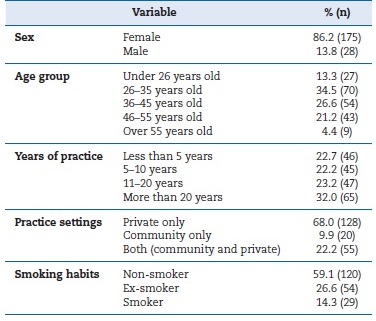
The study sample comprised 203 oral hygienists, corresponding to 24.9% of the target population. Table 1 summarizes the sample characteristics, including demographic, professional profile, and smoking details. The mean age was 37.7 years (SD=10.5), and the mean work experience was 14.1 years (SD=10.16).
Table 1. Sample characterization regarding demographics, professional profile, and smoking habits (n=203).
Regarding the perception of oral hygienists on smoking cessation, most oral hygienists (78.8%) agreed or totally agreed with the importance of acting as smoke-free role models. Also, more than half totally agreed that the oral hygienist plays na important role in smoking cessation (59.6%) and that they have a responsibility to support and motivate smoking cessation (51.2%). However, only 22.7% considered themselves to have knowledge of smoking-cessation procedures (Table 2).
Table 2. Oral hygienists’ perceptions of and trainingon smoking cessation (n=203).
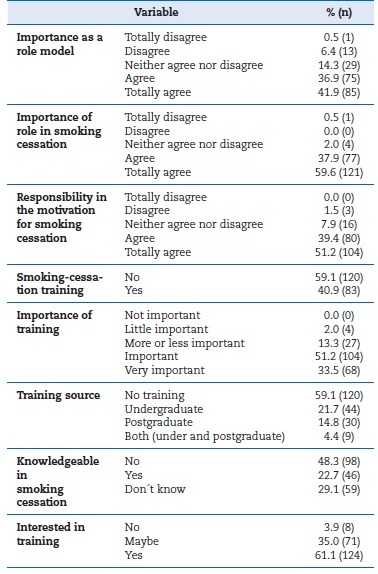
When asked about the importance of smoking-cessation training, about half (51.2%) considered it important, and 33.5% considered it very important. About 59.1% of the sample reported never receiving training on the subject. The ones who did took this training during their undergraduate studies (21.7%), graduate studies (14.8%), or both (4.4%). Approximately 60% of participants expressed interest in training in this area (Table 2).
Regarding knowledge on smoking-cessation procedures, 37.4% hygienists were aware of the brief intervention, 26.6% of the very brief intervention, and 27.1% of the intensive intervention (Figure 1). Other types of intervention were also mentioned by 4.4% of the participants, including hypnosis, acupuncture, ear soft laser, and the use of drug therapy.
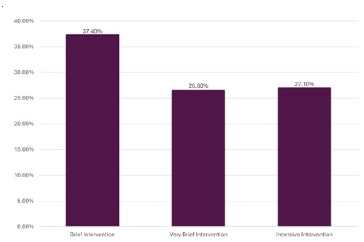
Figure 1. Knowledge about procedures for smoking cessation.
In their clinical practice, 67.7% of oral hygienists reported recording patients’ smoking habits often or very often; 76.0% included a reference to the harms of tobacco during consultations often or very often; and 59.1% mentioned discussing the benefits of quitting smoking often or very often. About onethird of the participants (33.3%) did not refer patients to specialized smoking-cessation programs, and more than half (53.6%) did not or rarely advised patients on alternatives to tobacco for quitting smoking. Most (63%) oral hygienists spent less than five minutes on smoking cessation during their consultations, and only 1% spent between 10 and 20 minutes on these procedures (Table 3). Nearly half of oral hygienists (47.0%) working in community settings reported engaging in smoking-cessation awareness or prevention activities. These efforts were primarily directed at young people aged 12 to 19 years (59.8%).
Table 3. Smoking-cessation intervention in clinical practice (n=183).
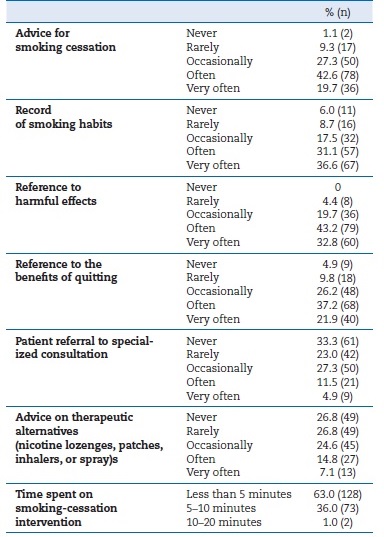
*These results include 183 participants because 20 oral hygienists were exclusively in community practice.
Among the barriers to smoking-cessation counseling during consultations reported by participants, the most common were the patient’s lack of interest in quitting smoking (82.0%), lack of training (78.1%), lack of time during consultations (62.3%), and difficulty in referring the patient (62.3%).
Other barriers included a lack of materials and the patient’s smoking status (Figure 2).
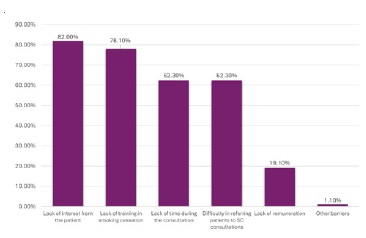
Figure 2. Barriers perceived by oral hygienists to providing smoking-cessation (SC) counseling.
The relationship between smoking-cessation counseling and factors such as years of practice, training, and smoking habits is presented in Table 4. No differences were found between smoking-cessation counseling and the years of practice or training (p>0.05). A relationship was found between the smoking habits of oral hygienists and counseling for smoking cessation (p=0.026). These professionals are more likely to promote smoking cessation when they are smokers. Still, smoker hygienists also have a higher rate of not providing this counseling.
Table 4. Relationship between smoking-cessation intervention in clinical practice and years of practice, training, and smoking habits (n=183).
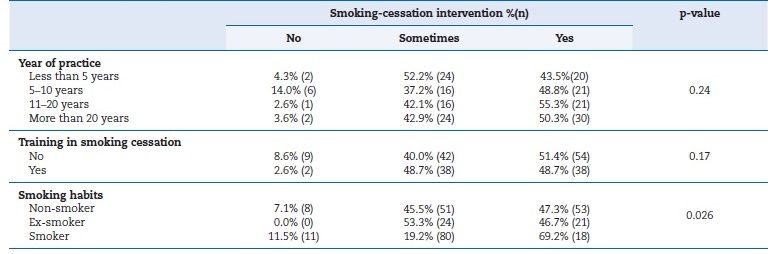
Test – χ2. P-values in bold are statistically significant.
*These results include 183 participants because 20 oral hygienists were exclusively in community practice
Discussion
Every year, millions of people worldwide die from tobacco use or exposure to secondhand smoke.2 It is important to understand the role of oral hygienists in the smoking-cessation process and the strategies they use to help patients quit. Smoking cessation requires a multidisciplinary approach, and oral hygienists can play an important role, even in brief, consistente ways, in their practice. They can seize every opportunity, whether during patient visits or community outreach, to encourage behavioral change.
Although the study included approximately one-quarter of the estimated total population of oral hygienists in Portugal, the sample was obtained through a non-probabilistic convenience sampling strategy, according to data from the Portuguese Association of Oral Hygienists (APHO). Data were collected through an online self-administered questionnaire, which may be subject to selection bias, as participation was voluntary and may have attracted respondents with a greater interest in the topic. In addition, self-reported data may introduce social desirability and recall bias. The absence of a defined response rate and the cross-sectional design limit causal inference. Therefore, while the findings provide a relevant and meaningful insight into the practices and perceptions of this professional group, they should be interpreted with caution and cannot be considered fully generalizable to all oral hygienists in Portugal.
Participants’ perceptions of their importance in supporting smoking cessation and as role models were very positive. The vast majority of oral hygienists (97.5%) agreed or totally agreed that their role can be instrumental in helping patients quit smoking. This result aligns with a narrative review indicating that between 70% and 96% of dentists or dental students considered smoking cessation an essential practice.19 Another study reported that 90% of dentists and hygienists considered that helping patients quit smoking is part of their role, indicating a strong sense of responsibility.
The smoking status of healthcare professionals can adversely affect their involvement in smoking-cessation interventions.21, 24 In the present study, oral hygienists recognized the importance of acting as role models, with most agreeing or totally agreeing that healthcare professionals should set a non-smoking example. However, about 14% of oral hygienists reported being smokers, which served as a barrier to adopting smoking-cessation procedures, highlighting the significance of this relationship. Even so, the results of this study showed that smoking participants may still hold positive attitudes toward helping their patients quit smoking. The results highlight some ambiguity among smoking participants regarding smoking-cessation interventions, probably influenced by their level of dependence and their awareness and perception of the harm caused by their habit. While some hygienists may feel a stronger sense of empathy and connection with smoking patients, leading them to actively engage in cessation efforts, others may find that their own smoking makes them more hesitant to promote these procedures.
Since smoking remains a relatively common habit among healthcare professionals, as shown in this study, it may be important to introduce targeted educational sessions for this group. These sessions should focus on increasing awareness of their own behaviors, boosting their motivation to quit smoking, and improving their ability to promote smoking cessation among patients effectively. This could help reduce the uncertainty some professionals might have about cessation practices.
The training was also very well perceived by participants, with most rating it as “important” or “very important” and expressing interest in learning more. Even so, 59.1% of participants reported never having received training in this area.
These findings stress the need to invest in ongoing training, including short postgraduate modules or webinars, and to include or reinforce specific smoking-cessation content in undergraduate curricula.25 The literature highlights a lack of training in smoking-cessation procedures not only in oral hygiene curricula but also among other oral health professionals.19, 24, 26 In a study in which these professionals received training in behavioral interventions and therapies to help patients quit smoking, nearly all participants (98%) reported using the skills they learned in their clinical practice. However, after three months, this fell to 78%, highlighting the need for reinforcement strategies and ongoing monitoring to sustain the training’s effectiveness.25 Continuous training is essential so that these professionals can systematically incorporate smoking-cessation interventions into their consultations and activities, thereby improving their skills and confidence in applying the most up-to-date, evidence-based practices. This updating becomes even more important with the emergence of new forms of smoking.
About two-thirds of oral hygienists reported advising patients who smoke to quit often or very often, supporting studies where the percentages range from 33.3% to 87.5%.27 However, when it comes to patients with periodontal disease, hygienists show a different attitude, asking more frequently about smoking habits and providing more counseling. This indicates that hygienists tend to value counseling more when they see a direct risk linked to oral conditions, especially periodontal disease, demonstrating their ability to implemente smoking-cessation strategies. Nonetheless, these results also show that not all patients are approached systematically.
Most hygienists (67.7%) revealed recording patients’ smoking habits often or very often, consistent with findings from other studies.27, 28 The most reported way to address smoking was to list the harmful effects of tobacco on oral and overall health, which aligns with other health professionals’ research studies.28,29 These practices are important because showing the adverse effects of smoking during check-ups might encourage patients to quit.30 Another common method was to mention the benefits of quitting smoking. Telling patients about the advantages of stopping, both for oral and overall health, can motivate them to quit and support the success of counseling efforts.30
In contrast, only a few participants (16.4%) referred their patients to specialist consultations often or very often, which is less than in a study of California dental professionals (34.8%).28 After specific training programs, this rate can increase significantly, reaching about 90%.25 The low number of referrals to specialized smoking-cessation services in this study suggests that oral hygienists may lack confidence o awareness of existing referral pathways. Improving their training, increasing their familiarity with public and private services, and building their confidence in engaging with these resources are essential steps to ensure patients receive full support to quit smoking. Professional organizations may play an important role in disseminating information and promoting training on smoking-cessation interventions and referral pathways. Additionally, oral hygienists should be encouraged to familiarize themselves with the referral resources available within their workplaces and healthcare institutions, particularly those working in hospitals, primary healthcare centers, or local health units, where specialized smoking-cessation consultations may already be available internally.
Few oral hygienists reported recommending therapeutic alternatives to tobacco often or very often (21.9%), even though evidence shows that combining behavioral counseling with nicotine replacement therapy increases quit attempts, reduces cigarette consumption, and improves abstinence rates compared with control groups.31 Other approaches, such as e-cigarettes, lack consistent scientific evidence of effectiveness6, 32 and are not currently endorsed by international health authorities.
Regarding the duration of counseling, 37.0% of hygienists reported spending 5 minutes or more per consultation, whereas other studies reported lower proportions (19%).29 Brief and very brief intervention strategies can last less than 3 minutes and represent an effective, feasible, and practical alternative for clinical settings.12,16 These interventions have shown positive outcomes, helping patients create a cessation plan, manage withdrawals, and address relapses. However, it might be necessary to refer them to specialist consultations.33
The findings on procedures used in clinical oral hygiene practice indicate that hygienists can advise patients on smoking cessation, record their smoking habits, and discuss the associated risks and benefits. However, it is essential to adopt a more structured approach, integrate brief interventions into routine visits, and, when necessary, encourage referrals to specialized programs.
There are few studies on anti-smoking awareness campaigns led by oral hygienists in community settings, but these campaigns should be considered as part of a multidisciplinar approach. School-based prevention programs, such as the European Smoking Prevention Framework, have proven effective in reducing smoking initiation among adolescents (12-15 years) and in developing self-efficacy to refuse smoking. The impact of these initiatives increases when the school community is involved, including motivated and well-trained teachers34, rather than just health professionals. Despite the significance of these community efforts, nearly half of the hygienists reported not engaging in community activities related to smoking. However, other health professionals in primary public services might perform these activities. These efforts are very important because they extend beyond current smokers to include primary prevention measures aimed at young people, which is especially important in vulnerable populations with limited access to information and healthcare services.
Several barriers to implementing smoking-cessation interventions by oral hygienists were identified. The most common barrier was patients’ lack of interest and resistance (82.0%).
Other studies have reported this barrier as less frequent, with rates ranging from 45.0% to 60.9%.21, 28, 35 Despite this inherent challenge in smoking cessation, oral hygienists must play na active, persistent role in emphasizing the consequences of tobacco use, especially in the oral cavity, and highlighting the short- and long-term benefits of quitting.31
The lack of training and knowledge was another major barrier, as studies show that between 48.3% and 61% of professionals report needing more training.21, 28 Training is also the simplest factor to address and can enhance safety, technical skills, and the proper use of tools such as the Fagerström35 and Richmond37 tests, as well as the implementation of brief, very brief, or motivational interviewing interventions.
Higher education institutions and professional associations play a key role in overcoming this obstacle by supporting the training of these professionals through the incorporation and reinforcement of smoking-cessation topics or modules into degree curricula, offering practical workshops, and developing implementation guidelines for clinical and community settings.
Specific training in this field, whether at the undergraduate, graduate, or continuing education level, is vital for introducing, improving, and updating knowledge of smoking cessation over time.19
Lack of time and the need to consult smoking-cessation specialists were also significant barriers. The issue of limited time can be addressed by delivering a brief or very brief intervention during the consultation, which can take only a few minutes and is both practical and easy to implement in clinical practice.28, 35 Difficulty with referrals is often linked to a lack of knowledge about services. It is essential for hygienists to stay informed about the referral options available in their area. Information about patient referral services can also be included in training programs.
This study highlights the importance of prioritizing smoking cessation and integrating it into oral hygienists’ professional practice, particularly in clinical settings. To support hygienists in delivering brief and very brief interventions as part of routine practice, it is recommended that pre-graduate and ongoing training for students and professionals be strengthened. The training approach should not be limited to theoretical knowledge; it should also focus on developing practical competencies that are applied directly during training consultations. This approach will boost confidence in implementing these interventions and underscore their significance in the clinical setting.
Due to their brevity, brief and very brief interventions provide practical, feasible, and systematic tools for integrating cessation counseling into routine practice. Targeted training, combined with clear protocols and practical guidance, can enhance clinicians’ confidence, transform reactive approaches into preventive strategies, and reinforce the oral hygienist’s central role in promoting smoking cessation and preventing tobacco-related diseases. When appropriate, they may also use validated tools such as the Fagerström36 (Supplement S1) and Richmond37 tests to evaluate nicotine dependence and motivation to quit.
These brief interventions are recommended and should adopt a patient-centered approach with an appropriate algorithm (Supplement S2). They can be delivered for a short duration and with minimal time commitment, overcoming the consultation time barrier. Despite their brevity, these interventions have significant clinical value. If used collectively by all healthcare professionals, they may promote a coordinated, active, and multidisciplinary effort against tobacco use and related diseases.
Conclusions
Most participants in this study recognized the importance of their direct involvement in smoking cessation and regarded it as integral to their professional responsibilities. However, over half reported never having received specific training in this area, revealing a significant gap in both academic and professional preparation. Many expressed interest in further training, emphasizing the value of developing targeted competencies.
Despite this gap, respondents reported using various cessation practices, including patient counseling, recording smoking habits, and communicating the oral and general health risks of tobacco. Interventions, however, are often selective, primarily addressing patients with periodontal disease, reflecting a reactive rather than preventive and systematic approach. Key barriers include patient disinterest, insufficient professional training, and limited consultation time.
References
1. World Health Organization. WHO report on the global tobacco epidemic, 2023: protect people from tobacco smoke. Geneva. 2023.
2. GBD 2019 Tobacco Collaborators. Spatial, temporal, and demographic patterns in prevalence of smoking tobacco use and attributable disease burden in 204 countries and territories, 1990-2019: a systematic analysis from the Global Burden of Disease Study 2019. Lancet. 2021;397(10292):2337-60.
3. Ministério da Saúde. Direção-Geral da Saúde. Programa Nacional para a Prevenção e Controlo do Tabagismo. Lisboa: DGS, 2019.
4. McClure JB, Bush T, Anderson ML, Blasi P, Thompson E, Nelson J, et al. Oral Health Promotion and Smoking Cessation rev port estomatol med dent cir maxilofac . 2026;67(2) :71-79 77 Program Delivered via Tobacco Quitlines: The Oral Health 4 Life Trial. Am J Public Health. 2018. 108(5):689-695.
5. Chang J, Meng HW, Lalla E, Lee CT. The impact of smoking on non-surgical periodontal therapy: A systematic review and meta-analysis. J Clin Periodontol. 2021;48(1):60-75.
6. Tomar SL, Hecht SS, Jaspers I, Gregory RL, Stepanov I. Oral Health Effects of Combusted and Smokeless Tobacco Products. Adv Dent Res. 2019;30(1):4-10.
7. D’Ambrosio F, Pisano M, Amato A, Iandolo A, Caggiano M, Martina S. Periodontal and peri-implant health status in traditional vs. heat-not-burn tobacco and electronic cigarettes smokers: a systematic review. Dent J (Basel). 2022;10(6):103.
8. Siewchaisakul P, Luh DL, Chiu SYH, Yen AMF, Chen CD, Chen HH. Smoking cessation advice from healthcare professionals helps those in the contemplation and preparation stage: na application with transtheoretical model underpinning in a community-based program. Tob Induc Dis. 2020;18:57.
9. Aveyard P, Massey L, Parsons A, Manaseki S, Griffin C. The effect of transtheoretical model based interventions on smoking cessation. Soc Sci Med. 2009;68(3):397-403.
10. Tseng MF, Huang CC, Tsai SC, et al. Promotion of Smoking Cessation Using the Transtheoretical Model: Short-Term and Long-Term Effectiveness for Workers in Coastal Central Taiwan. Tob Use Insights. 2022;15:1179173X221104410.
11. Prochaska JO, Di Clemente C. Transtheorical therapy: toward a more integrative model of change. Psychotherapy: Psychother Theory Res Pract. 1982; 19(3):276-288.
12. Dawson GM, Noller JM, Skinner JC. Models of smoking cessation brief interventions in oral health. N S W Public Health Bull. 2013;24(3):131-134.
13. Stead LF, Buitrago D, Preciado N, Sanchez G, Hartmann-Boyce J, Lancaster T. Physician advice for smoking cessation. Cochrane Database Syst Rev. 2013;2013(5):CD000165.
14. Antal M, Forster A, Zalai Z, Barabás K, Ramseier C, Nagy K. Attitudes of Hungarian dental professionals to tobacco use and cessation. Cent Eur J Public Health. 2012;20(1):45-49.
15. European Commission. Tobacco control in the EU: fact sheet. Brussels: Directorate-General for Health and Consumers; 2009.
16. Rebelo L. Intervenção breve no paciente fumador: aplicação prática dos “5 As” e dos “5 Rs”. Rev Port Med Geral Fam. 2011;27(4):356-61.
17. Warnakulasuriya S. Effectiveness of tobacco counseling in the dental office. J Dent Educ. 2002;66(9):1079-1087.
18. Pau A, Olley RC, Murray S, Chana B, Gallagher J. Dental hygienists’ self-reported performance of tobacco cessation activities. Oral Health Prev Dent. 2011;9(1):29-36.
19. Chan HL, Chan AKY, Chu CH, Tsang YC. Smoking cessation in dental setting: a narrative review on dental professionals’ attitude, preparedness, practices and barriers. Front Oral Health. 2023;4:1266467.
20. Jannat-Khah DP, McNeely J, Pereyra MR, et al. Dentists’ self-perceived role in offering tobacco cessation services: results from a nationally representative survey, United States, 2010-2011. Prev Chronic Dis. 2014;11:E196.
21. Saito A, Nishina M, Murai K, et al. Health professional’s perceptions of and potential barriers to smoking cessation care: a survey study at a dental school hospital in Japan. BMC Res Notes. 2010;3:329.
22. Grech J, Sammut R, Buontempo MB, Vassallo P, Calleja N. Brief tobacco cessation interventions: practices, opinions, and attitudes of healthcare professionals. Tob Prev Cessat. 2020;6:48.
23. Brown EM, Hayes KA, Olson LT, Battles H, Ortega-Peluso C. Dentist and hygienist smoking cessation counseling and awareness of Medicaid benefits. J Public Health Dent. 2019;79(3):246-252.
24. Alblowi JA. Perception of Tobacco Counseling and Cessation among Dental Practitioners. J Smok Cessat. 2021;2021:6692525.
25. Coan L, Windsor LJ, Romito LM. Increasing Tobacco Intervention Strategies by Oral Health Practitioners in Indiana. J Dent Hyg. 2015;89(3):190-201.
26. Rani V, Khosla R, Sharma R, Kunsi SR, Chandran T, Ali AKS. Training and Education for Dental Professionals on Tobacco Cessation. J Pharm Bioallied Sci. 2024;16(Suppl 4):S3260-S3262.
27. Alsiwat AJ, Alayadi HM. Knowledge, attitude and practice of smoking cessation counseling among dental hygienists in Saudi Arabia. Tob Prev Cessat. 2022;8:09.
28. Chaffee BW, Urata J, Couch ET, Silverstein S. Dental Professionals’ Engagement in Tobacco, Electronic Cigarette, and Cannabis Patient Counseling. JDR Clin Trans Res. 2020;5(2):133-145.
29. Dalia D, Palmer RM, Wilson RF. Management of smoking patients by specialist periodontists and hygienists in the United Kingdom. J Clin Periodontol. 2007;34(5):416-422.
30. Parker DR. A dental hygienist’s role in tobacco cessation. Int J Dent Hyg. 2003;1(2):105-109.
31. Binnie VI, McHugh S, Jenkins W, Borland W, Macpherson LM. A randomised controlled trial of a smoking cessation intervention delivered by dental hygienists: a feasibility study. BMC Oral Health. 2007;7:5.
32. Vyas N, Bennett A, Hamel C, et al. Effectiveness of e-cigarettes as a stop smoking intervention in adults: a systematic review. Syst Rev. 2024;13(1):168. Published 2024 Jun 29.
33. Cheng CCW, He WJA, Gouda H, et al. Effectiveness of Very Brief Advice on Tobacco Cessation: A Systematic Review and Meta-Analysis. J Gen Intern Med. 2024;39(9):1721-1734.
34. Vitória PD, Silva SA, de Vries H. Longitudinal evaluation of a smoking prevention program for adolescents. Rev Saúde Pública. 2011;45(2):344–354.
35. Rosseel JP, Jacobs JE, Hilberink SR, et al. Experienced barriers and facilitators for integrating smoking cessation advice and support into daily dental practice. A short report. Br Dent J. 2011;210(7):E10.
36. Fagerström KO. Measuring degree of physical dependence to tobacco smoking with reference to individualization of treatment. Addict Behav. 1978;3(3-4):235-241.
37. Richmond RL, Kehoe LA, Webster IW. Multivariate models for predicting abstention following intervention to stop smoking by general practitioners. Addiction. 1993;88(8):1127-1135.
Sónia Mendes
E-mail address: soniaborralho@edu.ulisboa.pt
CRediT authorship contribution statement
Catarina Salvador: Conceptualization; Data curation; Formal analysis; Investigation; Methodology; Resources; Validation; Writing – original draft. Sónia Mendes: Conceptualization; Data curation; Methodology; Supervision; Validation; Writing – review & editing.
Ethical disclosures
Protection of human and animal subjects. The authors declare that no experiments were performed on humans or animals for this study.
Confidentiality of data. The authors declare that they have followed their work center protocols on access to patient data and for its publication.
Right to privacy and informed consent. The authors have obtained the written informed consent of the patients or subjects mentioned in the article. The corresponding author is in possession of this document.
Conflict of interest
The authors have no conflicts of interest to declare.
Acknowledgments
The authors would like to thank the Portuguese Association of
Oral Hygienists (APHO) for their support in disseminating the
questionnaire among oral hygienists.
1646-2890/© 2026 Sociedade Portuguesa de Estomatologia e Medicina Dentária. Published by SPEMD.
This is an open access article under the CC BY-NC-ND license (http://creativecommons.org/licenses/by-nc-nd/4.0/).